News Blog

Watching Sport – Third Place in the Group

29th June 202

The bloated nature of the 2026 FIFA World Cup has necessitated 72 Group matches to be played in order to reduce the number of participants from 48 to 32.

There have been 12 Groups of 4 teams from which the top two in each Group – along with the 8 third-placed teams with the best records – have qualified for the knock-out phase of the Last 32. The hierarchy of criteria for deciding the “best” third-placed teams was: points obtained in the Group (3 for a win, 1 for a draw); goal difference; goals scored; and “fair play”, based on the number of red and yellow cards obtained. (The Last 32 phase began yesterday when Canada beat South Africa in Los Angeles).

The table shows the rank order of the third-placed teams at the Group stage:

Rank Group Team Points Goal difference
Qualifiers for Last 32
1 K DR Congo 4 + 1
2 F Sweden 4 0
3 L Ghana 4 0
4 E Ecuador 4 0
5 B Bosnia-Herzegovina 4 – 1
6 J Algeria 4 – 2
7 D Paraguay 4 – 2
8 I Senegal 3 + 2
Non-qualifiers
9 G Iran 3 0
10 A South Korea 3 – 1
11 C Scotland 3 – 3
12 H Uruguay 2 – 1

Scotland’s failure to qualify for the knock-out phase – a key objective in this tournament, given that the country had never previously done so when fewer sides took part in the Finals – has had an immediate effect, with the resignation of the manager, Steve Clarke. In addition, not surprisingly, it has prompted an avalanche of analysis, explanation and anguish in the media from ex-players, experts, non-experts, supporters et al: the manager’s tactics, the under-performance of leading players, the absence of genuine stars, the lack of opportunity given to young Scottish players by the major domestic clubs… The cottage industry of opinion and solutions will no doubt flourish for some time.

In their Group, Scotland – 42nd in the FIFA world rankings before the tournament started – beat Haiti (ranked 83rd) 1-0 before losing 0-1 to Morocco (ranked 7th) and 0-3 to Brazil (ranked 6th): one win and two defeats with only one goal scored and four conceded.

An inevitable characteristic of the Scotland post mortem is that lots of “what if” questions are posed. “What if the score had been B rather than A?” “What if Country X had only drawn with Country Y rather than scoring a last-minute winner?”. This type of counterfactual conjecture can be interesting, but it is limited for the simple reason that nothing changes in isolation. The dynamics of a Group’s evolution are just that – dynamic – and a change in one detail is likely to have brought about a reaction (and possible effect) elsewhere.

Nonetheless, one argument being widely put forward is that, given the difficult nature of the Group (as shown by the FIFA rankings of Morocco and Brazil), Scotland should not have been satisfied with the slender lead they obtained against lowly Haiti – the single goal registered by a deflected shot by John McGinn – but gone all out to register a bigger win.

The table shows the limitations of this argument. Other things being equal – a crucial caveat – Scotland could have scored another 4 goals against Haiti (to win 5-0 and produce a final goal difference of +1 rather than -3), but this would not have produced any more points in the Group table and still left them behind Senegal in the third-placed rankings given in the table above.

The stand-out feature of the third-placed table is that 7 of the 8 qualifiers secured 4 points at the Group stage. Only Senegal qualified with 3 points – their goal difference of +2 courtesy of a 5-0 win over Iraq in their last match – and they would not have done so had Iran not had what they thought was a late winner disallowed in their final Group match against Egypt. (Those “what ifs” again).

Given that the World Cup Finals now have 48 teams and this method of qualification for the Last 32 knock-out phase is in place, there is no guarantee that securing 4 points in the Group stage will be a sufficient condition to progress. At the extreme, it is possibly that the third-placed teams in all 12 Groups could have 4 points. Likewise, it is possible that they all have 3 points. Or, indeed, one point.

A statistical exercise provides some illumination. Let us assume that, for a team playing in a Group match, there is an equal probability (i.e. one in three) of a win, draw or loss. The total number of permutations of results in a 4-team Group (in which 6 matches are played) is therefore 3 to the power 6, or 729.

Each of these permutations produces final points totals for the 4 teams. In 271 cases (37%), the third-placed team will have 3 points, whilst in another 286 cases (39%), the third-placed team will have 4 points. However, there is also a small number of cases – 12 in all, or 1.6% – in which the third-placed team would have 5 or 6 points, which means that the probability of coming third and having 4 points or higher is almost 41%. (For completeness, the probability of the third-placed team having only 1 or 2 points is 22%).

In practice, the assumption used here of a drawn match – a one-in-three probability – is probably too high. In this year’s Group stage, 20 of the 72 matches – 28% – were draws. This means that more matches than I have assumed will generate 3 points (to the winning side) rather than 2 points (shared between the two teams), with the result that a higher proportion of third-placed sides will be likely to reach 4 points or more than the base estimate of 41%.

In terms of this tournament, what all this confirmed, of course, was my view after Scotland’s first match that, notwithstanding the media frenzy and general euphoria surrounding the win over Haiti, they had not necessarily done enough to qualify for the Last 32 by virtue of that result alone. The single goal margin of victory meant that, in the event of defeat by both Morocco and Brazil, Scotland would end up with 3 points and a negative goal difference. This is precisely what happened.

What also happened was that some of the lowly-ranked teams in other Groups obtained vital draws against supposedly much higher ranked opposition: DR Congo (ranked 46th) against Portugal (5th), Bosnia-Herzegovina (64th) against Canada (30th) and, especially, Ghana (64th) against England (4th). When combined with their wins against the sides that came bottom of their respective Groups (Uzbekistan, Qatar and Panama), this gave them 4 points and a secure place amongst the list of third-placed Group qualifiers for the Last 32. This effect was compounded when Ecuador (ranked 23rd) unexpectedly won their last Group E match against Germany (10th) – who had already qualified for the Last 32 – also taking them to 4 points.

In retrospect, I would judge that Scotland’s inability to secure a point from their Group match against Morocco was the crucial factor in their non-qualification for the knock-out phase. As noted, it was only a narrow loss (0-1) – and Scottish supporters will argue long into the night that their side should have been awarded at least one penalty kick. However, a 1-1 result – again with the significant caveat of “other things being equal” – would have put them amongst the list of qualifiers at the expense of Senegal.

Finally, a statistical quirk. The performance of Cape Verde (ranked 67th by FIFA) in Group H yielded 3 points and a zero net goal difference. From the table above, it can be seen that this outcome was the same as that of Iran in Group G and inferior to any of the third-placed qualifiers for the Last 32 knock-out phase.

But Cape Verde are in the knock-outs: they play Argentina in Miami on Friday. The reason: they came second in their Group and qualified automatically. Three matches: three draws – against Spain (ranked 2nd), Uruguay (16th) and Saudi Arabia (61st). It was Uruguay that came third in the group – with 2 points – thereby taking the lowest place (below Scotland) amongst the third-placed non-qualifiers.

Watching Sport – The Last Slice of Yorkshire Parkin

25th June 2026

For the traditionalist followers of county cricket – of whom I am one – the current structure of the Championship season leaves much to be desired. Of the 14 matches played by teams in the First Division, only two are scheduled in the three-month period between mid-May and mid-August. The remainder of this time is left clear for various forms of one-day game.

For Yorkshire, one of those games was the 4-day match that began in Leicester last Friday. I took in the second day. It was my first visit to Grace Road – now the Uptonsteel County Ground – which, having been Leicestershire’s home ground between 1877-1901, has also fulfilled that function since the end of the Second World War.

The match represented the beginning of the second half of the County Championship season and was of importance for both sides. Having been promoted from the Second Division last season, Leicestershire had not won any of their first 7 matches this year and were rooted at the foot of the table. Yorkshire were in 7th position in the 10-team division, though only 16 points behind leaders Essex, who were one point ahead of Sussex and three points ahead of Somerset. It promises to be a closely contested Championship this year.

In my teenage years, my immersion into the history of Yorkshire cricket revealed the strong Leicestershire connection, as several former Tykes had successful careers with their second county. Between the 1950s and 1970s, these included Willie Watson, Dickie Bird, Jack Birkenshaw, Chris Balderstone and, of course, Ray Illingworth, who also went on to captain England. After being released by Yorkshire in 1968 at the age of 36, Illingworth captained Leicestershire for 10 years during which time they won 4 one-day trophies and (in 1975) the County Championship.

[An aside: When also in my teens, I was invited for a trial at Leicester by the then secretary, Mike Turner. For various
reasons, I did not take up the invitation, so – in theory at least – it is a case of the road not travelled.
In reality, probably not, I think].

Leicestershire had had much better of the first day, dismissing Yorkshire for 185 and then registering 177 for 3 in reply. On Saturday, they consolidated their position with the overnight batsmen Rehan Ahmed and Nick Kelly both making centuries. The efforts of the Yorkshire seam attack met with meagre reward and it was the spin bowlers Dan Moriarty (4 for 85) and Dom Bess (2 for 47) who had more success, the innings closing at 453 all out at 10 minutes to six.

Towards the end of the Leicestershire innings, I noticed a curious piece of play. With one ball left of the 110th over, the total had reached 447, meaning that, if the home side scored another 3 runs off that delivery, they would secure a fifth batting bonus point. The Yorkshire captain Jonny Bairstow (successfully) posted all his fielders on the boundary in order to prevent this happening. I interpreted this as Bairstow perhaps recognising that that single point might be of significance at the end of the season when the league table is finalised and the two relegation places are decided.

Yorkshire had an hour’s batting to safely negotiate in their second innings, the day having been extended following an earlier rain break. They were not successful: 32 for 2 was their overnight score.

And so I saw a disappointing day from a Yorkshire perspective. But I had also now visited Grace Road, an established part of the fabric of the English county game.

I had entered at the southern end of the ground and walked past the Mike Turner Cricket Centre. I don’t think that even the keenest Leicestershire supporter would describe Grace Road as a picturesque ground – there are too many functional buildings from the 1960s and 1970s for that – but it does have its particular characteristics. From my vantage point under a pagoda on the far side from the entrance – one of the few locations at which to take shelter from the drizzle and then the sun – I had a good view from third man as the right-handed batsman takes guard at the pavilion end; the surrounding streets had a good quantity of mature trees; it was possible to walk round the ground without losing sight of any of the play; a window table in the first-floor Meet café and bar provided an excellent view over the playing area; and, not least, there was the Friends of Grace Road cake stall which, on this occasion, offered a very good Yorkshire Parkin. (I secured the last available piece). I should also report that the stewarding was pleasantly friendly and the two scoreboards were operated very efficiently.

Given that there were two scheduled days left to play, Yorkshire would have resumed their innings on Sunday knowing that they would probably have to bat until lunchtime the following day to get anywhere near saving the match. They fell well short, being dismissed for 229 by teatime, that total having been reached only due to the last two wickets contributing 95 runs. (Moriarty, batting at number 10, made a maiden first-class half-century). Leicestershire secured their first First Division win since 2003 by the substantial margin of an innings and 39 runs.

With six Championship matches still to be played (from the 3rd week of August through to end-September), Yorkshire are now 8th in the table. Below them, are Hampshire and Leicestershire, both of which have now inflicted heavy defeats on the Tykes this season. On the current evidence, it would appear that Yorkshire could be entangled in the relegation battle, which will recommence immediately on the resumption of the Championship fixtures: their next two games are against Hampshire at Southampton and Leicestershire at Scarborough.

Finally, I should also mention that my cricketing day in Leicester on Saturday had started with the taxi ride to the ground from the railway station. I learned that my driver had been born in Pakistan and been something of an all-rounder in his day, also playing for club sides in London and Leicester, both of which had been hugely supportive in assisting him with his cricket expenses. He informed me – not that I needed telling – that it was absolutely ridiculous for the England seam bowlers to be consistently pitching the ball short to the New Zealand tail-enders. “They need to be bowling yorkers”, he said, “Two or three yorkers each over”.

The wonderful power of cricket: to create a mutually respectful and informative – if only temporary – connection between complete strangers.

Watching Sport – The Sports Archaeologist

9th June 2026

When I was a young boy, my mother and I would collaborate on completing the weekly Littlewoods Pools coupon. By choosing 16 numbers from the list of that week’s matches, she would identify the selection of drawn games for the “Treble Chance”. I would meticulously study the league tables to predict the outcomes – home wins, away wins or draws – for my chosen fixtures in the “Nine Results” category (all of which had to be correct to qualify for a prize). Our successes might have been both (very) occasional and (very) modest, but they were invariably greeted with a sense of achievement and the promise of larger riches to follow.

My contribution to the pools coupon did not only force an understanding of which teams were doing well or badly in that year’s league tables in England and Scotland. It also encouraged the development of my geographical knowledge, as I sought to find out where some of these clubs were on the map. Most were straightforward, of course – Aberdeen, Wolverhampton Wanderers, Torquay United et al – but others were far less so, particularly in Scotland. Where exactly were the locations of Heart of Midlothian and St Mirren and Third Lanark?

Then, at the beginning of the 1967-68 season, I noticed that the name of Third Lanark had disappeared from the pools coupon.

Last Sunday, I attended the Greater Glasgow Programme and Memorabilia Fair, which was held in a room at Queen’s Park FC, next to the national stadium at Hampden Park. It was an enjoyable and interesting event. There was a free entry – and, later, free teas/coffees and sandwiches – and we were greeted at the door by the Fair’s organiser, who thanked us individually for coming. There were a dozen or so stalls manned by vendors selling a range of football-related merchandise: mainly vintage match programmes, but also old tickets, badges, photographs, replica shirts, etc. I turned up about a quarter of an hour after its official 10.00am start and the room was already nearly full.

Casual observation suggested that there was a range of potential customers. I suspected that I was one of a number of unattached attendees who just had a general interest in the event and the types (and prices) of the items on sale. By contrast, it was clear that other potential purchasers had more defined objectives. I noticed more than one consulting his list – the clientele was almost entirely male – of specifically targeted programmes, as if seeking to complete personal collections.

It was not surprising that the stalls focusing on the respective memorabilia of Rangers FC and Celtic FC had sizeable gatherings. The prices of some of their match programmes from the distant past – ranging from major European matches to friendly games on pre-season tours – seemed to be amongst the highest being sought, in a couple of cases eye-wateringly so. But the overall range of material available across the room extended far beyond that of the Old Firm. Afterwards, I spoke to a man who was delighted to have purchased some programmes from Motherwell FC’s adventures in Europe.

It has to be said that, before attending the Fair, I had determined that I could not leave empty-handed. And for some reason – a flashback to the time of completing the pools coupons with my mother, perhaps – I thought that a Third Lanark match programme would be a good choice. That would be a fiver well spent, I reasoned.

The initial search was not encouraging. There were some Third Lanark programmes on display at one of the stalls, but the attached prices were (very) considerably above my provisional budget as they were of big matches against, in some cases, Old Firm opposition. A conversation with another stallholder revealed that the Third Lanark programmes tended to be in short supply at these types of events, which suggested that the fundamental laws of supply and demand were in operation.

Later, I engaged in a chat with another stallholder who asked me if I was interested in anything in particular. I mentioned Third Lanark with some hesitation, remarking that I had been looking for something at a reasonable price. “I’ve got a Third Lanark”, he said and, from one of the boxes in front of him, immediately produced the official programme for a League Cup tie against Airdrie in August 1963. The programme was in very good condition and presented in a plastic wallet on which the price of £10 was marked. “I’ll sell it to you for a fiver”, he said. I produced a note from my jacket pocket and we shook hands.

The programme – originally priced at three (old) pence – is of eight pages with red print (the club’s colour) on a white background. The “editor talking” section, covering the better part of three pages, includes the keen anticipation of Third Lanark’s forthcoming First Division league fixtures against both Rangers and Celtic. The line-up of the two teams is presented in the centre spread, the surrounding advertisements including local establishments such as Paddy Neeson’s Bar at 165 Allison Street G2 where WM Younger’s Beer or Guinness’s stout is “always served in prime condition”. At two addresses in Kilmarnock Road S1 and Drakemire Drive S4 are branches of “Hershelle” Ladies and Gents Hair Stylists. The only annotation on the programme is the final result, which is given as a 2-1 win for Airdrie; in fact, it was Third Lanark who prevailed by that score.

Having made my purchase and, later, drunk my coffee, I made another circuit of the room before departing. I had not finished with Third Lanark Athletic Club however, as, in the foyer outside the room, there was another stall which focused on the former club. It was manned by a gentleman of about my age – attired in a replica shirt – who was not attempting to sell any items but, instead, was simply presenting some memorabilia: action photographs from big matches, a splendid picture of the club’s home stadium at Cathkin Park, a flag in the club’s colours from a corner post, an old football.

We had a nice conversation. The man told me about the club’s formation in 1872, the First Division League Championship success in 1903-04 and the three former Third Lanark players who had played in major European cup finals, including the veteran Ronnie Simpson, who had been in goal for Celtic in their famous 1967 European Cup win against Inter Milan in Lisbon.

With sadness in his voice, he then spoke of the club’s rapid decline and demise in the early 1960s: the good players sold cheaply, the recruitment of inferior replacements – I found out later than none of the August 1963 side featured in the club’s final game in April 1967 – the lack of any adequate financial management in the latter years, the fraud. In June 1967, a liquidator having reported to the Court of Session in Edinburgh that the liabilities considerably exceeded the liquid assets, the club was wound up.

In retrospect, I regret that I did not ask the man his name or, indeed, what his personal connection with the club had been, given that it folded 60 years ago. I assume it must have been his father’s – or even grandfather’s – team. In any event, there was another handshake and – a last-minute decision – I was on my way to Cathkin Park, about half a mile away along the Cathcart Road.

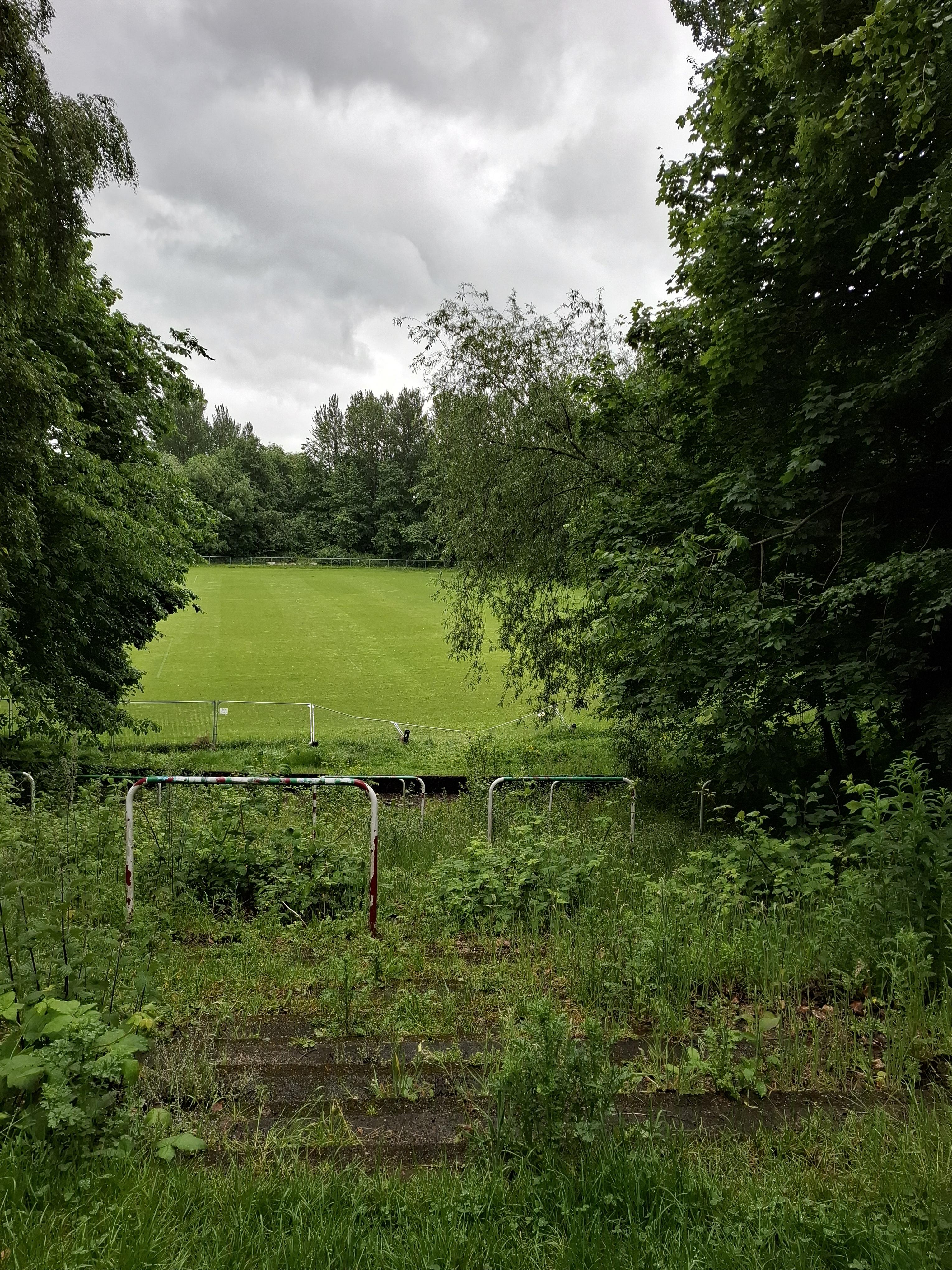
The centre of the park is a flat area with short grass and the markings of a football pitch though with the goalposts removed and the pitch surrounded by a metal fence. The embankments rise on three sides of the park, covered by mature trees. The most striking thing is that, on each of these sides, not only are the remains of large parts of the terracing clearly evident, but there are many of the short crash barriers – now heavily rusted – still in place. For the period of my walk around the park, gathering my thoughts and taking the occasional photograph, I was a sports archaeologist.

The club’s name lives on in the form of the Third Lanark Amateur FC, which mainly plays its matches at the nearby Toryglen Regional Football Centre and at the Barlia Football Centre in Castlemilk. In the 2025-26, the side finished 5th (out of 12) teams in the Hills Solicitors Colleges Championship within the Scottish Premier Amateur FA. The club’s Facebook page makes a clear link to previous times, stating that it was established in 1872 and reproducing an early badge with its prominent number 3.

Finally, back to old match programmes. I have written before – for example, in a Rugby League context, in “Windows into the Past” in the Rugby League Journal (Spring 2014), reproduced in Still An Ordinary Spectator – about their importance as significant social documents in their own right. Such memorabilia not only provide a source of personal reminiscence and enjoyment for sporting enthusiasts, they reflect – having been influenced by – the norms of the era and, accordingly, are important reference points for cultural and social historians.

In the modern era, the decline of the printed match programme reflects the rising costs of its production and distribution and, of course, the ready availability of instant and rapidly-changing information via social media. That is a loss, I think.

But in the meantime, as Sunday’s event at Queen’s Park FC showed, there remains a strong appetite for old match programmes and other memorabilia, in this case soccer-related. I invested £5 to buy a Third Lanark match programme of 63 years ago. It is a welcome addition to my collection.

Family History – Burial in the Gorbals

17th May 2026

In The Line of Sixteen, I record that one of my great (x3) grandfathers was Peter McBride, who was born in Port Glasgow in 1797 and died in the Gorbals, Glasgow, in 1864. He was a joiner and carpenter and his wife was Williamina (née Walker, c1801-1885).

I also noted that one of Peter’s brothers – William McBride – died in the Govan Poor House in 1857 at the age of 54. A former merchant seaman, he was single and his usual address had been in the local Dale Street – a street that occurs several times in the McBride records between 1841 and 1885. The cause of death, certified by the surgeon HA Liddell, was “paralysed, 2 years” and the informant on the death certificate was his sister-in-law, Williamina, who marked her name with a cross.

In the book, I state that William was buried in the Gorbals Burying Centre. At the time, this was actually called the Gorbals Burying Ground (and, later the Gorbals Burial Ground), which had been established in the first half of the 18th Century on Old Rutherglen Road to serve the village of Gorbals. (The location is clearly identified as the “Gorbells Burial Place” on the “Road to Rutherglen” in John McArthur’s 1778 Plan of the City of Glasgow: Gorbells and Caulton).

By the time of William’s burial in 1857, the nearby Southern Necropolis had been established over its 19 acres. The need for this much larger burial site, which opened in 1840, was graphically described in the December 1988 edition of the Southern Necropolis Newsletter:

First, the old burial ground, first established…. to meet the needs of the one-time village of Gorbals, was, by the late 1830s, in an appalling state; the unfortunates “on the Parish” were buried in long trenches, left barely boarded over until the trenches were full; it had been used for mass pit burials in the cholera outbreak of 1832; the bought lairs were full, and not much space was left.

Secondly, the city had its great Necropolis by the cathedral, and the new Sighthill cemeteries – both places of great dignity. Gorbals, now joined by Laurieston and Hutchesontown, and full of merchants and professional people and prospering mill owners and engineers, aspired to similar dignity. But with a difference. The dignity was to be shared by all.

Whether it was actually “shared by all” is perhaps a moot point. Clearly, William McBride was not in the class of “merchants and professional people” and his final resting place was destined to be at the old site.

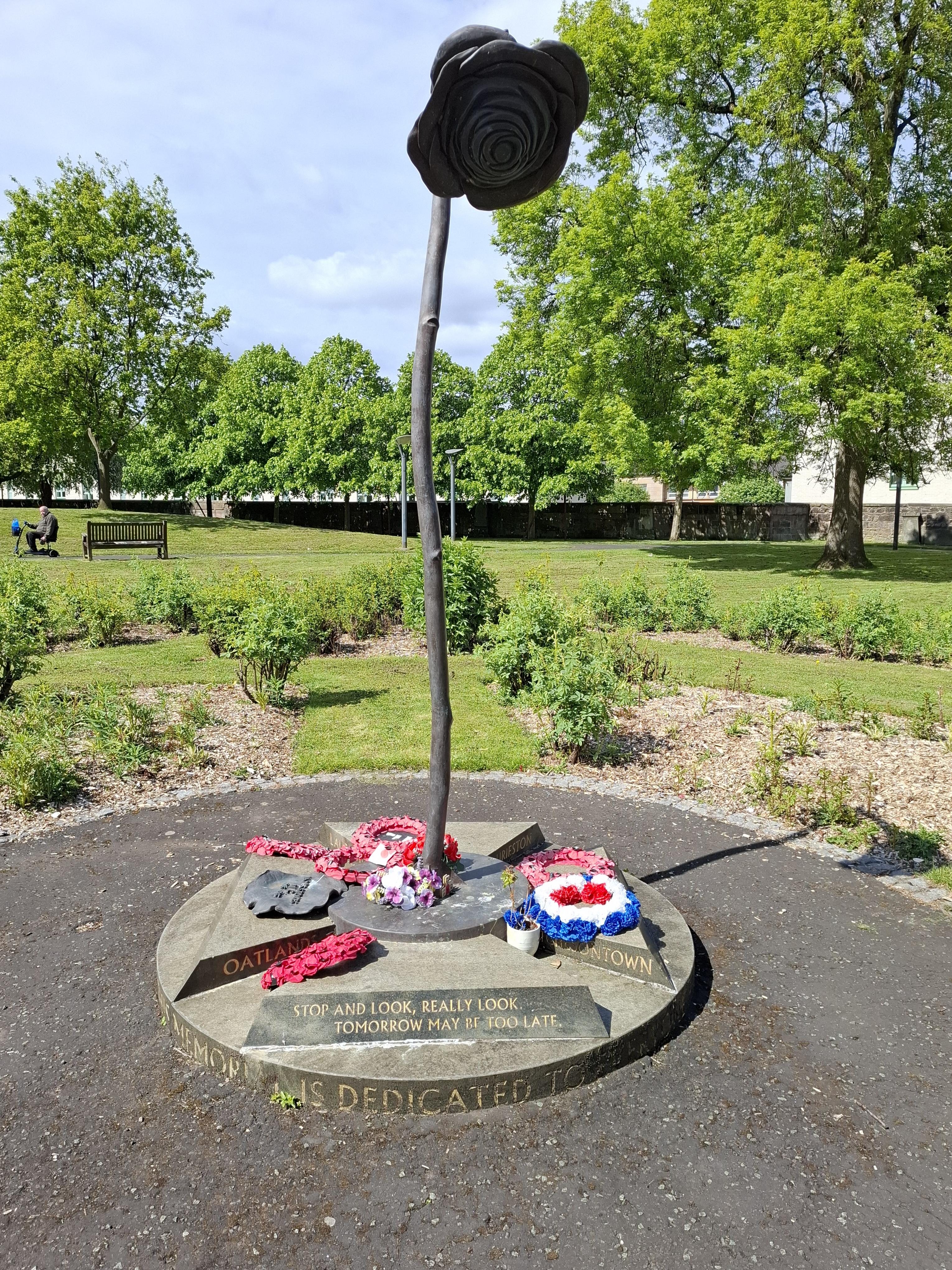
The former Gorbals Burial Ground is now a landscaped area maintained as a memorial garden – the Gorbals Rose Garden – which features historic headstones set into the boundary walls. I visited it yesterday on my way to participating in a guided tour of the Southern Necropolis that had been arranged by the Dunbartonshire Family History Society.

The centrepiece of the Garden is a large standing rose sculpture created by the local artist Liz Peden and unveiled in 2005. The inscription around the base reads “This memorial is dedicated to everyone from the Gorbals who served their country in times of conflict”, whilst another is “Stop and look, really look. Tomorrow may be too late”. There are plaques recognising the neighbouring localities of Oatlands, Laurieston and Hutchesontown and commemorating James Stokes VC (1915-1945). (Private Stokes, born in Hutchesontown, was in the King’s Shropshire Light Infantry. He received the British Army’s highest award posthumously for his gallantry in the face of the enemy at Kervenheim, Rhineland, in March 1945).

The Garden was a pleasant place in which to spend some time on a sunny early summer’s morning. It was neatly tended, the grass having been newly cut, and the trees over the former burial pits have reached a proper maturity. I have no idea where exactly William McBride was interred, but it was a worthwhile duty to visit the Garden and to pay him my respects.

The tour of the Southern Necropolis was hosted by Colin Mackie, an enthusiastic and knowledgeable guide. It was a very interesting two hours highlighted by the striking – in different ways – commemorations of the businessman and philanthropist Sir Thomas Lipton (who was born in the Gorbals) and the famed architect Alexander “Greek” Thomson.

Colin Mackie explained that, from its opening, there was a payments system through which lairs could be purchased in the Necropolis. This might explain why William McBride was buried elsewhere, if even the Necropolis’s cheapest rate had been beyond his means..

Watching Sport – “As you were” for the automatic promotion place

30th March 2026

At the end of the football season, one team will be promoted automatically from the 10-team Scottish Professional Football League 2 (SPFL2). The other promoted team will emerge from play-offs involving the teams finishing in second to fourth places and the second-bottom team of League 1. (The bottom team of League 1 will be relegated automatically).

Prior to last Saturday’s round of fixtures, East Kilbride FC and The Spartans FC stood at the top of League 2 on 56 and 55 points, respectively, with 6 games left to play. The third-placed team (Clyde FC) had 44 points and the fourth-placed (Forfar Athletic FC) 36 points. When the regular season and play-offs have been completed, therefore, it is possible that the second-placed team – which is obviously likely to be either East Kilbride or Spartans – having had the frustration of not going up automatically by a narrow margin, might well be squeezed out of the second promotion place by a side that had finished 20 points or so below them.

Saturday’s match between Spartans and East Kilbride in Edinburgh was therefore of some importance. Whilst both sides would have been aware that a win would not yet have guaranteed promotion, it would have been considered an important psychological staging post in that particular quest. An interesting quirk to the contest was the Spartans had won all the season’s previous three League fixtures between the clubs, including a 6-0 away victory in January, as well as a Scottish Cup tie in the autumn.

Some might consider the clubs as being arrivistes within the SPFL structure: Spartans from 2023-24 and East Kilbride this season. (By contrast, this year’s League 2 also includes Dumbarton FC, which secured its second Scottish Football League title in 1892-93, the year that Clyde joined the competition). However, it is the case that the new arrivals secured their League status on merit by virtue of being the previous season’s champions of the Lowland League and then winning play-off matches against the Highland League winners and the side finishing bottom of League 2.

On Saturday I took the Number 19 bus from the Waverley Steps into the northern part of the city, past the Western General Hospital and Fettes College to Crewe Toll, from where it was a five-minute walk to the Spartans’ home ground at Ainslie Park, aka the Vanloq Community Stadium. (“God bless you” said the cheery young man wearing a “Jesus loves you” t-shirt, as he paused from clearing up some of the litter on the Ferry Road. I hope my smile and wave was an appropriate acknowledgement). The weather in the west of Scotland had been wet and blustery earlier in the day so that, although it had turned to sunshine with a cool breeze in the capital, on arriving at the ground I took one of the few remaining places in the narrow stand that runs along the eastern touchline.

As expected, it was a good, competitive encounter. I thought that East Kilbride had the better of the first half, their passing having a greater fluency and with a consistently threatening outlet on the left hand side through Bobby McLuckie. His counterpart on the Spartans left, Ethan Drysdale, also showed up well with some good close control and dribbling.

Towards the end of the first half, Spartans had looked at their most dangerous from a couple of well-placed in-swinging corner-kicks and it was from one of these, 10 minutes after the break, that they took the lead through a header by their centre-back, Jordan Tapping. (By then I had enjoyed my half-time sustenance of a rather good flapjack, courtesy of the mothers’ and infants’ home-baking stall that was strategically placed at the end of the stand). Tapping was later announced by the MC as the Spartans’ player of the match: a good choice, I thought.

The East Kilbride equaliser came somewhat unexpectedly with 83 minutes on the clock, when Joao Balde was judged to have been fouled in the penalty area. (The Lisbon-born Balde, together with the Spartans’ captain – the Lancastrian James Craigen – were the only non-Scots in the two starting XIs). “That was never a penalty” said the elderly man to my right – the first vocalised opinion he had offered on the game though, judging by his frequent applause of the Spartans’ efforts, he was not exactly a disinterested spectator. I thought that there had been contact between the defender and forward though our different perspectives might have been due to looking into the brightly setting sun, which was facing us above the blocks of flats on the other side of the ground.

The combative John Robertson – East Kilbride’s leading scorer this season – confidently converted the spot-kick before sprinting towards the small but noisy band of travelling support in the smaller stand in the corner of the ground.

The final score of 1-1 meant that it is “as you were” after the two sides – watched on this occasion by over 1300 spectators – had completed their latest battle at the top of the League 2 table. There will no doubt be plenty of drama to come before the automatic promotion place is decided.

For the present, I enjoyed my visit to Ainslie Park, though I did come away with one regret – that I had not purchased a second flapjack to enjoy with my coffee on the train journey back to Glasgow Queen Street.

Watching Sport – Basketball Scores

26th March 2026

Three sides – Dumfries Saints, Preston Lodge and West of Scotland – are competing for the single promotion place from Division 3 of the Arnold Clark Men’s National League of Scottish club rugby. Prior to last Saturday’s fixtures, their respective points tallies were 55, 54 and 54 with the 4th placed team – Hillhead Jordanhill – some way back on 41 points. Dumfries had two matches to play, one fewer than their rivals.

As the weekend’s fixtures had pitted Dumfries against Preston Lodge, there was the opportunity for West of Scotland to overtake one of them – or, indeed, both in the unlikely event that they drew their match – were they to defeat Aberdeen Grammar Rugby in their home fixture at Burnbrae. I decided to make my first visit for a rugby union match on that ground since I saw West defeat Howe of Fife in what was then Division 3 of the Tennents National League in December 2021.

On a warm and sunny afternoon, it did not start well for West. After five minutes, a swift attack down the left wing resulted in a try for the visitors. However, two Aberdeen errors – one a dropped ball and the other an intercepted pass – quickly led to West tries within a couple of minutes of each other. Aberdeen then responded with a score under the posts. As all these tries were converted, it was 14-14 after 25 minutes. I suspected that this might be a high-scoring match.

But quite how high-scoring, I had not suspected. The final result was a 61-59 win for Aberdeen. If my notes are correct, the game had a total of 18 tries and 15 conversions with the lead changing hands 6 times between Aberdeen’s initial score and their final try under the posts with three minutes to go.

In the modern era, it is less uncommon for such “basketball” scores to be recorded in rugby union. Indeed, the recently completed Six Nations Championship included wins for Scotland by 50-40 over France and for France by 48-46 over England. (Thus, even the feted defence coach of France – Shaun Edwards – was obliged to watch his side concede a total of 96 points over two weekends). More relevantly for West’s current divisional interests, Preston Lodge edged out Dumfries Saints by 47 points to 43.

This is all a far cry from the (now distant) past, when the points on rugby union scoreboards would slowly advance – usually in multiples of three – as the teams slogged it out on mud-strewn pitches. 12 points to 9 would have been considered a high-scoring game.

In the case of the West-Aberdeen match, it might be thought that there were simply two poor defences. However, I don’t think this is an adequate explanation of the total of 120 points being registered in 80 minutes. Whilst some of tries were attributable to missed tackles or interceptions, I think that the scoreline was also reflective of some general developments in rugby union as a whole.

In particular, in recent years, the game has evolved in its attacking scope. There is much more thought now being given by coaches to the running lines within the back division and this has been allied to the honing of all players’ overloading skills in the tackle to maintain any attacking momentum. There is also much more variety in the types of kicks that are made (on the generally firmer pitches) within the opponents’ “red zone” (ouch). (I would argue that, to a significant extent, much of this reflects the passing down through the coaching hierarchy of some of the attacking skills brought into the union code from those grounded in rugby league). On Saturday, at Burnbrae, there was certainly no lack of commitment by either side in the tackle or in the scrap for the ball on the ground once the tackle had been made.

For Aberdeen, the captain Craig Shepherd led from the front with some strong running in the centre and was rewarded with a couple of touchdowns. The fly-half Dan McElderry added a lung-busting 75-yard interception try to his 8 conversions. For the home side, full-back Lewis Howick notched up 24 points from two tries and 7 conversions, whilst the winger Callum MacGugan benefited from some slick passing for his two tries. The hooker Gus Cameron also touched down twice, one of which was the result of a perfectly executed driving maul by the West pack from a short-range line-out.

At the final whistle of the two matches, Preston Lodge had taken over at the top of the table, their win – plus the try-scoring bonus point – taking them to 59 points with two games left to play. Both Dumfries and West registered two bonus points for try-scoring and the narrow margins of their defeats taking them to 57 and 56, respectively.

There is still much to play for, therefore, though the ball is clearly in Preston Lodge’s court, their remaining two fixtures being against the sides currently 8th (Strathmore) and 10th (Garnock) in the 10-team league.

Watching Sport – The Six Nations’ “La Ronde”

15th March 2026

The completion of this year’s Six Nations rugby union tournament allows us to identify an example of a sporting “La Ronde” – an unbroken circle of wins and losses between the participating countries.

Viz:

…England defeated Wales

Wales defeated Italy

Italy defeated Scotland

Scotland defeated France

France defeated Ireland

Ireland defeated England

England defeated…

This is the only combination of the 2026 results that produces this outcome. It is not perfect, as the results were not sequential during the tournament. However, it is sufficiently uncommon for it to be noteworthy – the first of its type since 2013 and only the fifth since the Six Nations began in 2000 with the introduction of Italy.

A positive interpretation is that the phenomenon reflects the unpredictability of the tournament which, this year, has also been characterised by some imaginative attacking rugby. Although the eventual winners (France) were perhaps the favourites when it started, there were two other sides (Ireland and Scotland) that could have been champions before the last round of matches were played. And, of course, it turned out that it required a last-minute penalty goal by the nerveless Thomas Ramos to win the final match for France (against England). Had his kick been unsuccessful, Ireland would have added the Championship to their Triple Crown success.

With acknowledgement to Arthur Schnitzler (1862-1931).

Family History – The Family of Jane Wells: Erratum and Expansion

11th March 2026

The mother of Jane Wells

In The Line of Sixteen: Searching for my children’s great, great grandparents, I note that my own great (x2) grandparents were George Rigg (1802-1865) and his wife Jane (née Wells, 1807-1886) and that they had 8 children, the youngest of whom (Henry Rigg, 1847-1920) was my great grandfather.

In a cell in Table 1.1 on page 18 of the book, I record that Jane Wells’s parents were Edward Wells (1767-1808) and Sarah Croft (born 1764). However, following further research, I have come across information that indicates that this pairing should be Edward Wells (1767-1831) and his wife Ann (née Ashton, born 1763).

This amendment does not affect any of the other details presented in the book’s numerous branches of the family tree. Nor does it cut across the impressively meticulous research that I was pleased to report a contributor to the Ancestry public pages – David Pratt – has undertaken in recording the direct line from Jane Wells back through eight generations to Robert Welles, who was born in Galphay, near Ripon, in about 1516.

Edward Wells and Ann Ashton were married in East Witton, North Yorkshire, in 1787. Edward – a labourer – signed the marriage certificate with his mark; Ann gave her name in neat handwriting (and without the ‘e’ that appears in some of the transcripts of her official records).

Their respective places of birth were approximately 25 miles apart and, as will be seen, this turns out to be a potentially complicating factor in the family story that follows. Edward – the son of Edward Wells (born 1727) and Mary Bilton (born 1732) – was born in the village of Cundall, near Dishforth. Ann was born in Middleham – a couple of miles from Leyburn – the daughter of George and Alison Ashton.

The main Ancestry source that has provided me with information on the family of Edward and Ann Wells is York, Yorkshire, England, Church of England Baptisms, Marriages and Burials, 1538-1812, which has been compiled from Anglican Parish Registers held at the Borthwick Institute for Archives in York. This shows that Jane Wells – the future wife of George Rigg – was born in November 1807 and baptised in February 1808 in the parish of Brafferton; Edward and Ann Wells are named as her parents. According to the same source, Jane had two sisters: Elizabeth Wells was baptised in Brafferton in June 1799 and Ann Wells in Cundall in December 1796. In the later Census records, Jane’s place of birth is given as Helperby. (Helperby and Brafferton are adjacent villages; Cundall is about two miles away).

I have not ruled out the possibility that Jane Wells also had a brother – William – who was born in either Middleham (as noted, also the birthplace of Ann Ashton) in 1788 or in Leyburn (which is only a couple of miles from Middleham) in 1796. The efforts I have undertaken thus far on William have been extensive – but also inconclusive – and present a good example of the frustrating “rabbit holes” that lie in wait for this type of research. Further work is required.

The trail of Elizabeth Wells – one of Jane’s sisters – is also hard to discern. The available databases do not suggest any obvious marriage leads to follow up. In the event that she remained unmarried, there is a death recorded for Elizabeth Wells in Kirklington in 1871 at the age of 71 (which would be consistent with her year of birth of 1799), but I am fairly certain that this is the former Elizabeth Harker from Constable Burton near Leyburn, who had married another William Wells (no relation) in 1823.

The descendants of Ann Wells

More positively, I am on firmer ground in the case of Jane Wells’s other sister, Ann. Accordingly, as The Line of Sixteen does not contain any discussion of Jane’s siblings, it is opportune here to expand the discussion of this part of the extended family tree.

Ann Wells married George Walker, a labourer from Cockfield in County Durham, in the parish of Topcliffe in 1823. Both signed the marriage certificate with a cross. Their elder son – also George – was born in Baldersby the following year. At the time of the 1841 Census, George and Ann Walker were still in Baldersby (recorded as 40 year-olds) with George’s occupation given as agricultural labourer and with another son, the 9 year-old Robert. (Ann’s sister lived next door, as that was the residence of George and Jane Rigg with 6 of their children). Ann remained in Baldersby for the rest of her life, dying in 1858 at the age of 61.

Between them, the two brothers – the younger George Walker (with his wife Elizabeth Lambert) and Robert Walker (with his wife Dorothy Ann Johnson) – had 11 children and it is the tracking of the subsequent generations that has provided me with a significant new outcrop of the extended family tree. George and Robert Walker were first cousins of my great grandfather – Henry Rigg – and I shall use them as my reference points in the discussion that follows. Their great grandchildren (whose homes ranged from Durham and Yorkshire to Ontario and California) were my 4th cousins. To date, I have tracked 150 family members (including spouses) over 7 generations from Ann Wells.

In 1851 – 10 years on from being recorded as an agricultural labourer – George and Robert’s father – George – was a 51 year-old “tanner, journeyman” in Baldersby. This occupation features significantly in several branches of the family – and for some as employers, not just workers. The younger George Walker established George Walker & Son in 1861 and, in 1881, is recorded as providing “employment for men and 2 boys” in Egglescliffe in County Durham.

This was only the start. One of George’s sons – John Walker (1856-1918) – incorporated Walker’s Tanneries Ltd as a private limited company in 1907 by which time he was firmly part of the North Yorkshire establishment: a member of the Northallerton Urban Council and a Justice of the Peace. John Walker became Governing Director of the company in 1914 with his sons – John and Frank – as Directors. On his death, the older John Walker’s effects totalled over £37,000 – the equivalent of £2.75 million today, according to Office for National Statistics data.

Many of the themes identified in The Line of Sixteen can be seen in the branches of the family tree that emanate from Ann Wells. One such is the dichotomy between the families that stayed in one locality for several generations and those who migrated overseas. The former include the Graves/Gill family that has lived in the southern part of County Durham for at least 5 generations and the 4 generations of the Walburn family in Northallerton. By contrast, it was Frederick Walker (1863-1937, a son of Robert) who took his skills as a blacksmith (together with his wife, Lilian, and their two surviving children) from Wetherby in Yorkshire to Preston in Ontario, Canada in 1911. Likewise, a grandson of George – Benjamin Howson Walker (1890-1947) – worked as a mining engineer and later a teacher in South Africa.

It is one of George Walker’s great grandchildren – William Arthur Walker – who provides us with another of The Line of Sixteen’s themes. He was a 24 year-old pilot officer with the Royal Canadian Airforce when he was killed in action in 1944. He is commemorated on the Commonwealth War Graves Memorial in Singapore. Previously, George’s brother Robert had lost a grandson in the First World War, when Herbert Walburn, a 33 year-old sapper in the Royal Engineers – and formerly a bricklayer in Northallerton – died in France in 1918. His commemoration is at the Loos Memorial at the Dud Corner Cemetery in Nord-Pas-De-Calais.

If and when The Line of Sixteen is updated and reprinted, William Arthur Walker and Herbert Walburn will be added to the Roll of Honour, which is given in Annex 4 of the book.

Watching Sport – Elite Sportsmen (Again)

11th November 2025

The game was one of unremitting ferocity, notwithstanding the stern discipline imposed by the referee, Eric Clay of Leeds, who sent off two Australians and the British prop, Cliff Watson. I remember sitting in the stand and being overawed – and, it has to be said, somewhat frightened – by the violence of grown men.

I have been here before. The quotation above forms the introduction to the last of the essays – “Elite Sportsmen at the Top of Their Game”, which covered the England-Australia rugby league international played at the London Stadium in a Four Nations Competition in November 2016 – in Still An Ordinary Spectator: Five More Years of Watching Sport (2017). The quotation itself refers to another match – Great Britain versus Australia at Headingley in November 1963 – to which I was taken when I was 9 years old and which is described in the opening chapter of An Ordinary Spectator: 50 Years of Watching Sport (2012).

A concept that has appeared occasionally in my writings on sports spectating over the years has been that of the “echo”: a low key reference to a character – or an incident or a place or a particular set of circumstances – that is subsequently revealed to have been of some significance or which involves a later recurrence of the action.

In 1963, the Great Britain-Australia encounter at Headingley was the third of a three-match Ashes test series, the Australians having won the first two matches (at Wembley and Swinton), in the latter scoring 12 (3-point) tries and registering a half-century of points. Last Saturday, I attended the third test of the 2025 series, played at Headingley, with Australia having won the first two games, this time at Wembley and the new Hill Dickinson stadium at Everton.

An “echo”, therefore, played out over a period of 60-plus years?

Perhaps – though I have to concede that there are differences in the respective sets of circumstances. In 1963, Australia regained the Ashes that they had lost in 1956 and Great Britain retained in the three following series, including in Australia in 1958 and 1962. By contrast, Australia came into the 2025 series having been in possession of the Ashes since 1973. (Great Britain’s last series win was in 1970, after which Australia won either 2-1 or 3-0 in the 13 subsequent series up to and including 2003, the last three-match contest prior to this year).

Following the thrashing at Swinton in 1963, the Great Britain selectors were in a position to transform the side for the Headingley match. They duly did so: there were no fewer than 10 changes to the 13-man team (in those pre-“interchange” days) with 7 players being awarded their first caps. It did the trick. The home side scored 4 tries – by debutants Geoff Smith, Johnny Ward and Don Fox and the Swinton winger John Stopford – with 2 goals from Fox completing a 16-5 win to avoid the whitewash.

For last Saturday’s game, the scope for the England coach – Shaun Wane – to radically change his personnel was more limited. He had announced a 24-man squad to contest the three matches and it was highly unlikely that he would look outside this group for additional resources. His 17-man selection at Headingley (including the 4 interchanges) showed only two changes from the corresponding group at Everton.

This suggested to me – and no doubt to other pundits (amateur and professional) – that whilst England would be likely to repeat their highly committed and effective defensive performance of the previous game, there was little to suggest that there would be a significant improvement in their attacking shape. This had been disappointingly pedestrian and unimaginative in the first two games, albeit confronted by an outstanding Australian defence.

As for Australia, a relevant question might have been: how would they perform having already fulfilled their principal objective of securing the Ashes? Would they take their foot off the gas and start thinking of home? Or would they feel relieved of the immediate pressures and release the potent attacking threat that had been seen only intermittently in the previous two matches? It was a redundant question, of course. These are professional athletes representing their country on the biggest international stage.

Both sides warmed up on the pitch for about 20 minutes in the autumnal sunshine, the Australians directly in front of my prime location in the North Stand about 25 metres from the try-line at the western end of the ground. Their preparations were done with intensity: the passing drills at speed, the forward rushes with uncompromising vigour, the kicking skills of half-backs Nathan Cleary and Cameron Munster with careful precision. I watched the latter spend a good five minutes practicing taking a series of passes and then, from the instep of his right boot, arching a number of curving grubber kicks over the opponents’ try-line.

England did not get the start they had wanted. The outstanding Australian hooker, Harry Grant, immediately made a surging run downfield from acting half-back. Shortly afterwards, the England winger Joe Burgess lost the ball in the tackle and then a superb looping pass from Munster exposed a badly organised English defence to create a try in the corner for Josh Addo-Carr. Cleary converted from the touchline: 6-0 to Australia after five minutes.

The second Australian try came after 25 minutes. The ball was moved from left to right in the England 20-metre zone. Munster took the pass and arched a curving right-footed grubber kick towards the England try-line. His second-row colleague Hudson Young – showing far greater commitment to the cause than the last line of England’s defence – arrived to dive on the ball and claim the try.

There is a famous quote, usually attributed to the golfer Gary Player: “The harder I practice, the luckier I get”. Munster had practiced his kick for a few minutes before the kick-off – and, no doubt, for many hours in many training sessions before that. I was back to the theme of my 2016 essay – the admiration of elite sportsmen at the top of their game.

England needed a response and it was brilliantly provided by Jez Litten – arguably their best player over the series – who, replicating Harry’s Grant’s earlier effort, made his own long break down the centre of the field before launching a perfectly judged kick for his captain George Williams to gather and score. Harry Smith’s conversion and a subsequent penalty on the stroke of half-time meant that the interval score showed only a 4-point margin – 8-12 – with all to play for.

The decisive period of the match was shortly after half-time. For what must have been a good 10 minutes, it seemed that virtually all of the play took place within the Australian 20-metre zone, where England – roared on by the capacity crowd – had a series of play-the-balls: at one stage they had three sets of tackles back-to-back. But, not for the first time in the series, the lack of creativity in their attacking options – combined with the disciplined resolution of the Australian defensive structure – was exposed. The opportunity passed and the play moved back downfield. When, with a quarter of an hour to go, the Australians had possession in front of the England posts, the alert Grant duly shot through a gap between two defenders and stretched his ball-carrying arm over the line for what we knew would turn out to be the matching-deciding try.

The echo of 1963 was not, therefore, to be fully sounded. There would be no home win on this occasion, but instead a repetition of another 3rd Ashes test at Headingly: that of 1982, when Max Krilich’s famous “Invincibles” side broke out in the closing stages of a previously tight game to secure a 32-8 win. On Saturday, it was almost the same: two Reece Walsh tries with the Cleary conversions took the final score to 30-8 in the Australians’ favour.

And so Australia have taken the series 3-0. I think that is what most pundits would have predicted before the first match kicked off. The sport is wealthier in Australia; on the field – in the National Rugby League – it is consistently played with a higher intensity and skill level than seen in the domestic Super League; off the field, it is administered with far greater clarity and purpose. What the “solutions” might be to the current – longstanding – gulf that exists between the two hemispheres will no doubt be the subject of much further debate within English rugby league. But let us not regard the outcome of this series as a “wake-up call”: the disparity has been evident for a very long time.

Finally, an observation on how the world around us has changed in the 60-plus years represented by this echo. I still have the tickets that my father, uncle and I had for the game in 1963: twelve shillings and six pence (62½p) each for seats in the North Stand with one shilling (5p) for the match programme. The corresponding costs in 2025 were £60 (plus a £1 administrative fee) – in the same (impressively modernised) stand – and £10. Such is the nature of our times. And – for the avoidance of doubt – it was great value for money.

Watching Sport – Cricket Substitutes: The Direction of Travel

23rd October 2025

The second of my blogs following up the August Test match between England and India at the Kia Oval reflects on the issue of substitutes in cricket (and some other sports).

The England seam bowler, Chris Woakes, dislocated his left shoulder when diving in the attempt to prevent the ball crossing the boundary during the Indian first innings. His injury meant that he could not take any further part in the match, apart from a short innings at its climax when he courageously took to the crease with his arm in a sling underneath his sweater. My earlier blog discussed the risks attached to this.

There has been some interesting comment on social media about the effect of Woakes’s absence on the Test and on the series as a whole. He was effectively missing for 3½ of the four innings of a game which India won by six runs. A counterfactual argument is that, had he been fit throughout, England would have prevailed – with, as a result, the home side winning the series 3-1 rather than settling for the 2-2 draw. (I have to say that, even in this example, I believe the case for the different outcome to be not proven; by definition, we simply don’t know how the conflict between bat and ball would have been resolved in the alternative scenario).

On balance, I would judge that the social media commentators generally favour cricket’s substitution rule as it currently stands in Test matches: that is, with substitutes allowed to field or keep wicket, but not bat or bowl, apart from covering injuries that are concussive.

For what it’s worth, I am also in this camp, although – as noted below – there is at least one glaring anomaly. However, rather than discuss the pros and cons of extending the grounds for more active substitutions, I shall examine what has happened in one or two other sports in order to ascertain what might have described as the direction of travel regarding the future of cricket substitutes.

Before doing so, a couple of other things, beginning with the anomaly. In the first innings of the Lord’s test match against New Zealand in 2022, the England spin bowler Jack Leach chased a ball to the Pavilion boundary and injured himself in his diving attempt to prevent the four being registered. For all intents and purposes, the cause of his injury was identical to that of Chris Woakes: a misjudged forward dive at full speed at the boundary’s edge whilst attempting to parry the ball back with the hand.

However, the outcome was different. Leach was found to have suffered a concussion. And the result of that was that, whilst he was ruled out of the remainder of the match, England were permitted to play a like-for-like replacement – Matt Parkinson – who bowled 15 overs and took one wicket in the New Zealand second innings. (An unbeaten Joe Root century steered England to victory by five wickets).

The second aside concerns the causes of the Leach and Woakes injuries. Whilst acknowledging their wholehearted commitment to their team’s cause – and recognising that every run saved might be crucial in determining the final outcome of the match – it is also the case that their injuries were self-inflicted when misjudging some part of the required acrobatics when they had a (very) outside chance of preventing the boundary.

In some regards, it is surprising that these injuries do not happen more often. For many fielders, it now seems to be de rigour that there should be a forlorn dive across the boundary rope (or whatever marks the boundary) even when it is perfectly obvious that the ball cannot be overhauled.

I have discussed this with a good friend, whose interest in cricket has extended from earlier than even my 60-plus years. “Something mistakenly macho” is the telling phrase that he used to describe the frequency with which players dive towards the boundary rope, rather than conceding the four runs as the inevitable outcome, as if not to do so would somehow constitute “chickening out”. In these cases, there is no chance of preventing the boundary, but a 100 per cent guarantee of a higher dry-cleaning bill and an “X” per cent chance of sustaining injury.

And so what of the future role of cricket substitutes? I wonder if a little history from elsewhere might be instructive.

In football, the employment of substitutes occurred – unofficially, without formal sanction – in many countries in the inter-war period. However, it was not until the 1965-66 season that they were permitted in English League Football: one per side and only to replace an injured player. Tellingly, two years later, the latter condition was relaxed to allow substitution for tactical reasons. (The first FIFA World Cup finals in which they were used were in Mexico in 1970). As from the 2024-25 season, Premier League teams have been allowed to name 9 substitutes, of whom 5 can be used.

The history of rugby league has many examples of depleted teams holding out against the odds, most famously the Northern Union side in the “Rorke’s Drift” Test match against Australia in Sydney in 1914, in which the visitors were at one stage down to 9 men from the original 13. (They won 14-6 to secure the Ashes). I can recall, from when I started watching the sport in the early 1960s, that it was customary, if at all possible, for injured players to hobble about on the wing to maintain their side’s numbers. Slightly before my time, the tourists’ captain, Alan Prescott, played all but 3 minutes of the Australia-Great Britain test match in Brisbane in 1958 with a broken arm (another GB win, 25-18).

These types of mad heroics were made less likely when substitutes were first permitted in senior rugby league matches in the 1964-65 season. Teams were allowed to replace two injured players in the first half, though the requirement for the player to be injured was abolished a year later. The modern rules – as set out in the 2024 Rugby League International Laws of the Game – are considerably different. Each team may have up to 4 replacements with a maximum of 8 “interchanges” allowed from the 17 named players.

As so often the case, the rugby union authorities followed their league counterparts with a lag. The laws were changed in 1968 for “matches in which a national representative team is playing” in which no more than two players could be replaced “only when, in the opinion of a medical practitioner, the player is so injured that he should not continue playing in the match”. In the same year, Barry John’s replacement by Mike Gibson in the first South Africa vs British Lions Test in Pretoria was the first such occurrence. The introduction of a replacement as a tactical substitute was not formally permitted until 1996.

These days, international rugby union is a game of 23-a-side as it is the norm for most (or indeed all) of the 8 available replacements to feature at some time in the second half of matches. This has produced some new forms of tactical thinking, as illustrated by the South Africans’ current propensity to employ a 6-2 (or even 7-1) division in the forwards/backs components of their replacements’ bench in order maintain the immense physicality on which their rugby strategy is based throughout the full 80 minutes.

These are different sports to cricket, of course. Nonetheless, if one is searching for pointers for the future of cricket substitutions – albeit most likely over the long term – I think there are two clear indicators.

First, it is very difficult to restrict the criteria than permit the use of substitutions. Mission-creep is all but inevitable over time. In all three of the other sports noted here, the restriction of allowing substitutes only for injuries was abolished – in the cases of football and rugby league very quickly – when it was evident that this condition was being abused through the feigning of injury by players (no doubt prompted by coaches and managers). At present, Test match cricket is holding the line with regard to concussion-related (only) injury and this is something that can probably be safeguarded through the use of technical medical examination. Other types of injury – a fast bowler supposedly straining a groin after bowling 6 overs at 90 mph with a like-for-like replacement waiting in the wings – would be more difficult to police.

Second, it is clear that the number of permitted substitutes tends to rise over time: from 1 to 8 in rugby union and (effectively via the interchange) in rugby league and from 1 to 5 in football. There are various factors at work here including the desire of sports authorities to maintain the speed of their games throughout their full duration as well as the need to safeguard players’ welfare when they might otherwise have been obliged to remain on the field when carrying injuries. (All three of the other sports also allow an additional substitution/replacement – for both sides – if a player has to permanently leave the field due to concussion).

Finally, reverting back to cricket, is there a straw in the wind evident in the some of the regulatory changes that have been recently introduced?

Earlier this month, Cricket Australia announced that, in the first five rounds of the current Sheffield Shield competition, teams will be able to replace a player if he sustains an injury or becomes unwell before, during or after play up to the close of play on day two. This would be at the referee’s discretion, the substitution must be like-for-like (such as a bowler for a bowler) and the opposing side would also be able to make a substitution. This followed a trial in the domestic red-ball competition in India earlier this year, though that was limited to injuries sustained on the field that were external, for example a deep cut or fracture rather than a muscle strain.

For the traditionalist, the more worrying development has been the Indian Premier League (IPL)’s “Impact Player rule”, introduced in 2023, which allows for changes that are purely tactical by permitting one substitute player per team (from 5 who are named beforehand) to play an active part in matches with bat or ball. Rather bizarrely, if a bowler, the Impact Player is allowed to bowl his full quota of four overs, irrespective of the number of overs bowled by the player he is replacing.

At present, the Impact Player rule only applies to the T20 format used in the IPL. It is still some distance from the first-class game, including Test cricket. Speaking for myself, I hope it remains there.